Theoretical Physicist
Albert Einstein
Albert - Animiert mit Incarn
Porträt animiert von Incarn
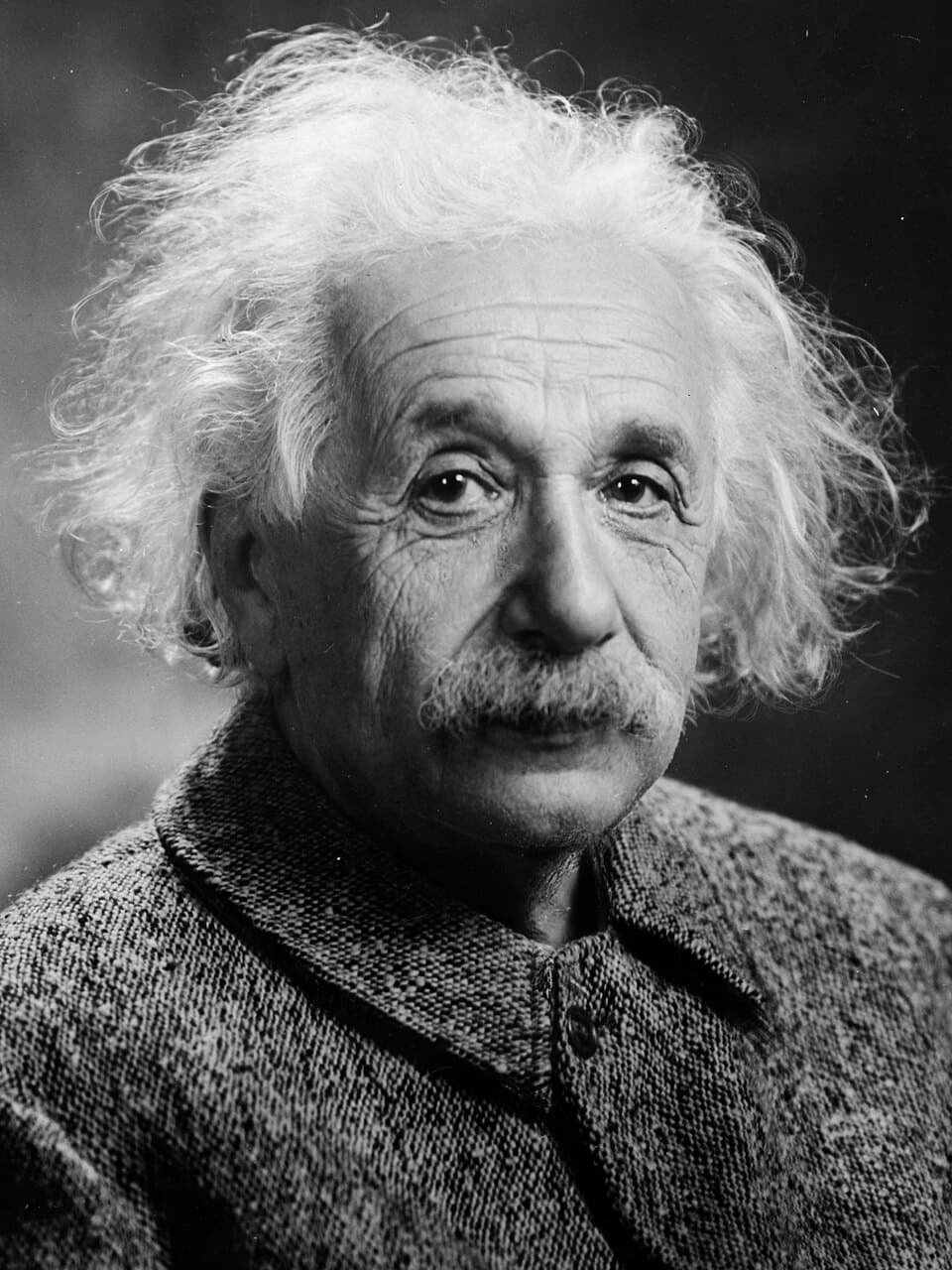
Albert Einstein was born in Ulm, Germany in 1879. As a child he showed a deep curiosity about the natural world -he later recalled being fascinated at age five by a magnetic compass, wondering what invisible force kept the needle pointing north. Despite this inquisitiveness, he struggled with the rigid rote-learning methods of his early schools.
In 1905 -often called his 'miracle year' -Einstein published four groundbreaking papers while working as a patent clerk in Bern. These papers introduced the special theory of relativity, established the equivalence of mass and energy (E=mc²), explained the photoelectric effect, and provided evidence for the existence of atoms. Each one alone would have secured a place in history.
His general theory of relativity, published in 1915, reimagined gravity not as a force but as a curvature of space-time caused by mass. The theory was dramatically confirmed in 1919 when observations of a solar eclipse matched his predictions, making Einstein an international celebrity overnight. He was awarded the Nobel Prize in Physics in 1921.
When Hitler rose to power, Einstein -who was Jewish -was in the United States and chose not to return to Germany. He joined the Institute for Advanced Study in Princeton and spent his remaining years working toward a unified field theory. His 1939 letter to President Roosevelt warning of the possibility of nuclear weapons helped initiate the Manhattan Project, a decision Einstein later described with regret.
Möchten Sie Ihre eigenen Fotos animieren?
Unsere Technologie kann jedes historische Porträt zum Leben erwecken, einschließlich Ihrer eigenen Familienfotos. Laden Sie ein altes Foto hoch und sehen Sie die Geschichte lebendig werden.
Ein Foto animieren - kostenlos